Limestone County Bedrock and Dumpster Placement
Limestone County's namesake bedrock means rockier or uneven ground in some yards and driveways — here's what that means for placing a dumpster safely.
Athens dumpster guide
Limestone County has a real history with severe spring weather, and storm cleanup brings its own delivery and debris-weight considerations. Here's what to expect.
If you’ve lived in the Athens area for any length of time, you already know why spring gets people’s attention around here. Limestone County sits in the Tennessee Valley corridor of what meteorologists call “Dixie Alley,” and this county has a documented, well-known history with severe spring weather. We don’t bring this up to be dramatic — we bring it up because it’s the honest reason storm cleanup is a real, recurring part of our business, and because knowing what to expect from a dumpster rental after a storm can save you time when you need it most.
Two of the most significant tornado outbreaks in U.S. history moved through Limestone County, and they followed strikingly similar paths. On April 3, 1974, during the Super Outbreak of that year, an F5 tornado tracked across the county, followed roughly thirty minutes later by an F4 on nearly the same path — sixteen deaths were recorded in Limestone County that day. Thirty-seven years later, on April 27, 2011, during the Super Outbreak of 2011, an EF5 tornado again cut across the county, one of seven tornadoes that touched down in Limestone County that single day. Four deaths were recorded in the county, and more than 700 homes and 84 businesses sustained damage. Researchers who later compared the two tracks — a UAH geography professor and a meteorologist, examining the paths independently — found they matched almost exactly. The community of Tanner, Alabama, a small unincorporated area in the county, was directly in the path both times.
We share these facts plainly and without embellishment because they’re part of the honest history of this county, and because they explain something practical: why so many households and businesses in Athens keep half an eye on the sky every spring, why storm shelters and weather radios are common here, and why, when severe weather does roll through, cleanup afterward is something we’re set up to handle quickly.
Spring in North Alabama brings the highest likelihood of severe thunderstorms and tornadoes, typically peaking from March through May, though the season can start earlier or run later in any given year. Basic preparedness matters more than any single piece of gear: know where you’ll shelter, keep a weather radio or reliable alert app active during watches and warnings, and have a plan for pets and family members who may need extra help getting to shelter quickly. None of this is unique to Athens, but it’s worth taking seriously here given the county’s history.
Storm cleanup is different from a planned renovation or cleanout, and we adjust how we deliver accordingly.
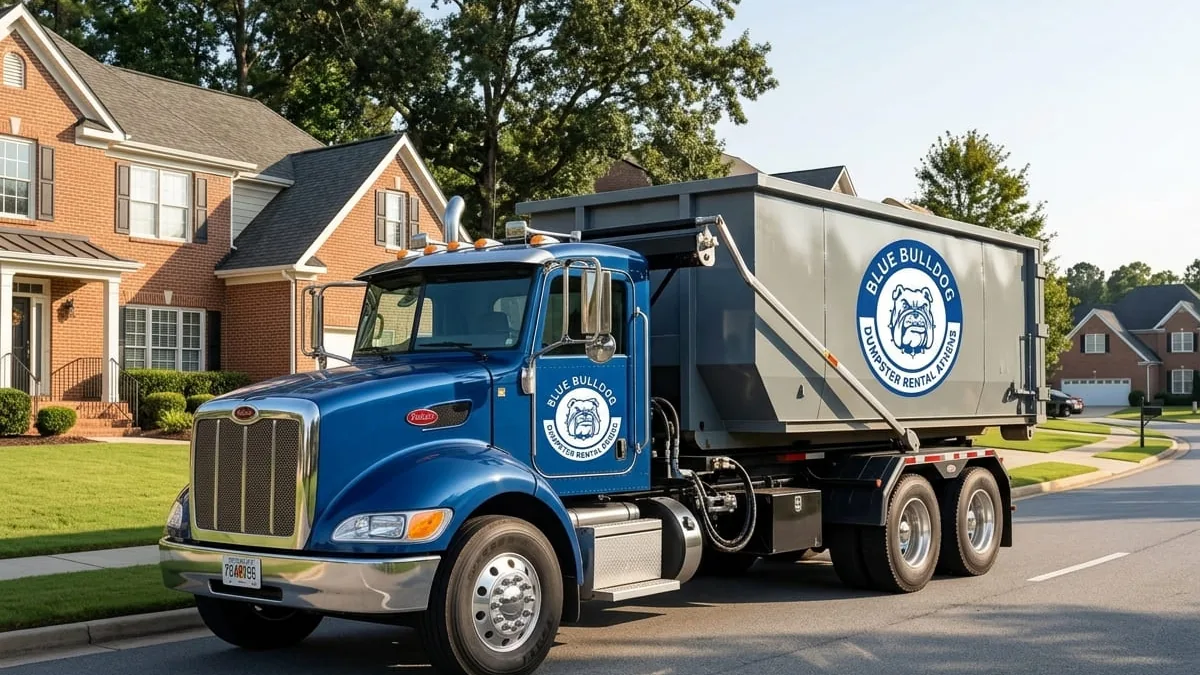
After a storm, yards and driveways are often littered with limbs, shingles, fencing, and debris the wind scattered from who-knows-where. Our trucks need a reasonably clear, level path to set the container down safely — if your driveway or yard is blocked by downed limbs or debris, let us know when you call so we can plan around it, or so you can clear a path before the truck arrives. A little bit of clearing up front saves a wasted trip.
Downed power lines, damaged trees still hanging in yards, and blocked streets are common in the days right after a severe storm. We check conditions before dispatching and will always prioritize safety over speed — if a line is down or a tree is unstable near where you want the container, we’ll wait until it’s cleared or find an alternate placement rather than risk our driver or your property.
Storm debris is often wet — soaked insulation, waterlogged drywall, rain-heavy tree limbs — and wet material weighs significantly more than the same material dry. This matters for sizing the same way shingle weight matters for a roofing job: a container that would easily hold a given volume of dry debris can hit its weight limit faster when everything is saturated. Tell us if you’re dealing with storm-soaked debris so we can size accordingly, rather than defaulting to a size based on volume alone.
Wind and hail damage to roofing is one of the most common calls we get after a spring storm moves through — see our roofing dumpster rental guide for how we size those jobs by square footage and layers. Beyond roofs, we handle downed-tree cleanup, damaged fencing, storm-wrecked outbuildings or sheds, and in more serious cases, structural debris from a home or building that took direct damage — our demolition debris service covers that heavier end of storm recovery.
If you’re working with an insurance claim, take photos of the damage — the roof, the yard, the debris pile itself — before any of it gets hauled away. It’s an easy step to forget when you’re in the middle of dealing with a storm, but adjusters generally want to see the damage as it actually was, not just hear a description of it after the fact. We’re happy to work around an adjuster’s timeline where we reasonably can, but if the container needs to come sooner for safety or space reasons, get your photos done first and let your insurer know the dumpster is on its way so nothing gets held up unnecessarily.
Storm cleanup rarely fits neatly into one category the way a planned renovation does. A single property might have roofing material, downed branches, water-damaged drywall, and general yard debris all at once, and each of those behaves differently in terms of weight and how it packs into a container. Rather than guessing a size over the phone, describe the rough mix of what you’re dealing with and roughly how much of it there is — that’s usually enough for us to recommend a size that won’t leave you short or paying for space you don’t use. If the damage is severe enough that you’re not sure where to even start, we’d rather talk it through with you on the phone than have you guess and end up with the wrong container.
Once the urgent debris is cleared, it’s worth doing a second walk-through of the property a few days later. Storm damage isn’t always obvious right away — a section of fence that looked fine can be leaning after the ground dries out, or a tree that seemed undamaged can show stress in the following weeks. If a second round of cleanup turns up after the first container is gone, we can schedule another delivery; there’s no reason to try to cram unrelated debris into a container that’s already been picked up.
After a storm, call us and describe what you’re dealing with — roof debris, downed trees, general yard cleanup, or something more serious. We’ll ask about access to your property and whether the debris is wet, and we offer same-day or next-day delivery when the schedule and conditions allow. We’re a locally owned crew based on Wilkinson Street in Athens, we know this county and its weather history, and we’re open Monday through Saturday, 7:00 AM to 7:00 PM, closed Sunday. Reach us at (256) 800-6590.
FAQs
Often yes. Storm debris is frequently wet, and wet material weighs more than the same material dry, which means the weight limit can be reached faster than volume alone would suggest. Tell us if the debris is storm-soaked so we can size the container accordingly.
We offer same-day or next-day delivery when scheduling and site conditions allow. Our first priority after a storm is always safety — if downed power lines, unstable trees, or blocked roads affect access to your property, we’ll work with you to find a safe placement or timing.
Let us know ahead of time if limbs, fencing, or other debris are blocking access. Our trucks need a reasonably clear, level path to set the container down safely, so clearing even a narrow path beforehand helps avoid a delayed or rescheduled delivery.
The county has real, documented history with it — violent tornadoes struck on nearly the same path during the April 3, 1974 and April 27, 2011 outbreaks, both passing directly through the Tanner community. That history is a big part of why storm awareness is a normal part of spring here.
Yes. Downed limbs, damaged fencing, and wrecked outbuildings are common after spring storms, and we size dumpsters for that kind of yard and property cleanup regularly. For heavier structural damage, our demolition debris service is built for that end of storm recovery.
Ready when you are
Call and you will speak to someone local who knows the streets, the permit rules and which box actually fits your driveway. Flat rate quoted up front.
Keep reading
Limestone County's namesake bedrock means rockier or uneven ground in some yards and driveways — here's what that means for placing a dumpster safely.
Curbside collection in Limestone County won't take furniture, appliances, yard waste, or construction debris — here's what that means and how recycling actually works locally.
From a single-room cleanout to a full renovation, here's how to match your project to the right dumpster size in Athens and Limestone County — and why weight matters as much as volume.